Standardization, competitiveness and clear rules to ensure the plastics industry's transition to the plastics economy.to circulate
The circular economy of plastics is at a turning point. Europe has raised the regulatory standard with Regulation (EU) 2025/40 of 19 December 2024 on packaging and packaging waste that came into force on 12 February 2025 and the strengthening of Extended Producer Responsibility for textile products. However, the current debate no longer revolves around how much regulation exists, but rather its consistency and enforceability.
The question dominating the industry today is deeper: Can the European circular system be competitive without losing technical rigor?
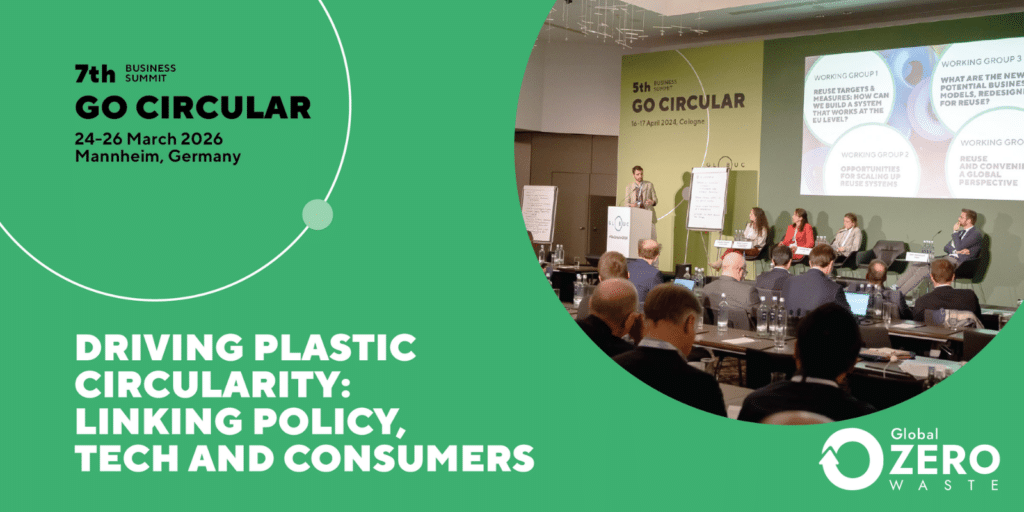
These topics will mark the 7th edition of the business summit GO CIRCULAR, to be held on March 25 and 26, 2026 in Mannheim, Germany, under the title “Promoting plastic clarity: linking policies, policiestechnology, technology, technology, technologyand consumers”.”.
Transparency and traceability in the standardization processes are key
In the panel “Global Perspectives: Leveling the playing field”, our Founder and CEO Sandra Pinzón will present the experience in the implementation of the Global Zero Waste Standard, with an approach based on standardization, measurement and technical verification.
Real cases of textile and packaging waste management implemented in different countries of the region will be shared, such as Falabella, a leading retail, e-commerce and financial services company, which operates mainly in Chile, Colombia, Peru, Argentina, Brazil, Mexico and Uruguay; and to Darnel Ajover, a multinational plastic packaging company with production plants in Colombia, Brazil, Argentina, Uruguay, the United States, Spain and Turkey.
As a leader of the Global Zero Waste Standard, Sandra will bring to Mannheim a technical approach focused on the evolution of materials and waste management systems towards structured, measurable and internationally comparable models. She will highlight how methodologies such as the Zero Waste Management System, based on performance indicators, compliance criteria and independent third-party verification, ensure traceability, methodological consistency and transparency throughout the material cycle.
For its part, Sabine Theobald, strategic relations coordinator and expert in the team of Global Zero Waste, will provide a perspective focused on the operational implementation of these standards in different regulatory environments. It will analyze how standardization can be adapted to diverse regulatory frameworks without losing technical rigor, demonstrating that methodological consistency is an enabler of competitiveness and an essential condition for building systemic trust in the circular economy.
InnovationThe technological ands implementation.Measurable
For years, the conversation about plastics focused on technological innovation, quality of recovered material, efficiency of mechanical versus chemical recycling and the transformation capacity of new plants. Today the challenge is different: to ensure that what is presented as circular can be demonstrated under technical criteria.
When standards are not aligned, ambiguities arise, real costs are distorted and the confidence of investors and buyers is weakened. In a context of volatility and international competition, operational clarity on how to measure, who certifies and under what criteria is crucial.
The circular economy has entered a phase of maturity. It is no longer just a matter of declaring commitments, but of structuring systems that make it possible to measure performance, recognize equivalencies and sustain competitiveness.
Under this approach, Global Zero Waste, a leading organization in international standards for circular economy, and Cercarbono, an expert in climate change mitigation mechanisms, have consolidated a strategic alliance to develop the Circular Economy Voluntary Program. This program is a robust market instrument that facilitates the recovery of materials throughout the value chain by trading Circular Credits, which finance environmental reduction and recirculation services. The integrity of this ecosystem is supported by the technological platform of EcoRegistry, which uses blockchain technology to ensure transparency, traceability and security in the registration of projects, avoiding double counting and allowing the international transfer of credits with total confidence for investors and buyers.
Participate in the conversation that will define the prós maximum decada
GO CIRCULAR will bring together regulators, investors and leaders from the textile and plastics industry's leading materials processing and management industries to move towards a verifiable circular economy.
Be part of the conversation - see you in Mannheim!